FOR DRUMMERS WHO WANT TO FINALLY PLAY THE SONGS THEY LOVE
Get your personalized roadmap to the songs you love in 45 minutes — without touching a single exercise
You send your list of songs before the call.
I build your roadmap around them.
You stop putting songs on hold.
Thank you
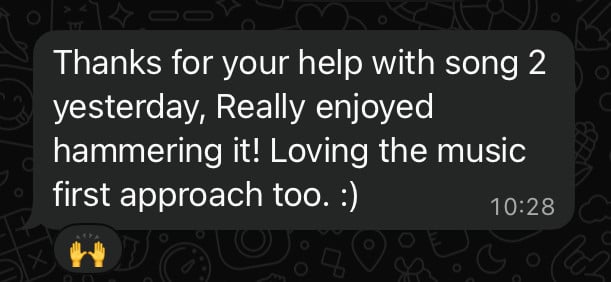
— Rich Jerwood
Does this sound familiar?
You've been practicing for months — maybe years — and the songs you actually want to play still feel out of reach.
You keep putting the songs on hold until the exercises are 'good enough' —but good enough never seems to arrive.
You can nail something slowly in isolation, but it falls apart the moment you press play.
You tried lessons before. YouTube tutorials. Method books.
You stopped — not because you didn't care, but because it stopped being fun.
You've started to wonder if you're just not talented enough — that some people don't have 'it' and that's just how it is.
You're not behind because you lack talent or because you haven't worked hard enough.
You're behind because the standard advice gave you the wrong strategy.
Exercises aren't the path to the songs.
The songs ARE the path — and always were.
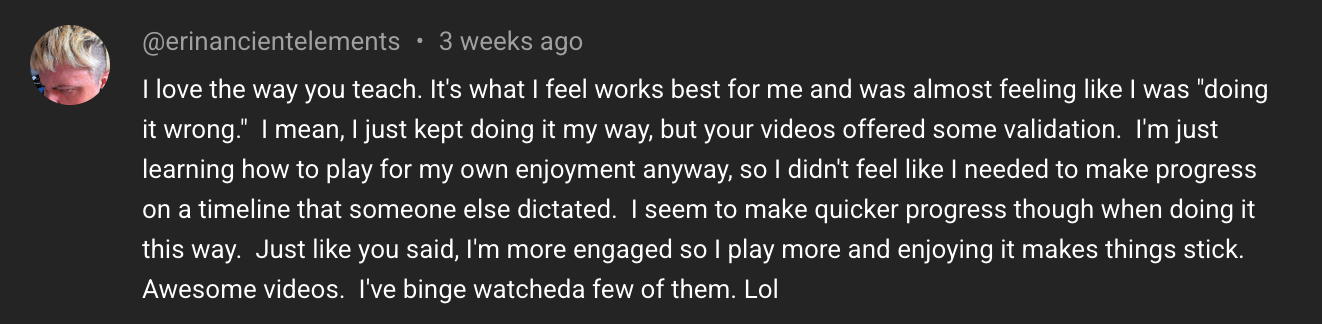
Why the standard approach fails
Here's what actually happens when you practice an exercise in isolation.
You get good at that exercise, but not how to apply the exercise.
The moment you try it in a real song — different tempo, different feel, a variation you didn't rehearse — it all falls apart.
That's not a talent problem.
That's what happens when you practice the drums out of context.
The standard way drums get taught assumes you can learn the parts first and then put them together with music.
That feels logical.
It's what most of us were told.
It's also wrong.
You can't learn a song by practising away from it.
The feel, the timing, the reaction to the other instruments — those only develop in the song itself.
You can't drill your way into feel. You can't exercise your way into pocket.
Students who complete their first full song — typically within 2 - 4 weeks aren't the ones putting in the most hours.
They're the ones spending the most time playing real songs — running into real problems and finding real solutions.
Technical exercises put you in the wrong place. Song puts you in the right one.

The Drum Roadmap: How it works
1. Send me your song list.
A list of tracks you want to play — any length, any genre.
Before we meet, you'll fill in a short form about where you're at and what you've tried.
This means we spend the 45 minutes on your roadmap, not catching up.
2. I build your roadmap before we get on the call
I look at your list and map the sequence — which song to start with, which ones build on it, and why.
When we meet, I walk you through the reasoning. You ask questions. Push back. Tell me where I've got something wrong.
It's built around your list. Not a generic curriculum.
3. You walk away with it in writing.
After the call, I send you the full roadmap as a written summary.
Your songs in order. What each one is developing. How to work with each track.
Nothing to reconstruct from memory. It's there when you need it.
Thank you
What you'll have at the end of 45 minutes
Your songs in the right order — starting with the one that will teach you the most, fastest.
A clear strategy for each track — what to listen for, how to approach it, what it will develop.
A way of listening to recordings that makes you a better drummer every time you put music on.
An honest answer to why your current practice isn't turning into music — and what to change.
A specific starting point — not 'practice more,' but exactly which song, and how.

Not just for adults — younger players get the same results:
Duke is really patient and Alex gets to help choose the music, which means that he practices an awful lot. I can't recommend Duke enough for kids who just want to play the drums and have a load of fun doing it.
— Kirsty (Parent)
FAQs
No. You're paying for the session itself — there's no up-sell on the call, no
pressure to buy more. If you want to continue working together afterwards, we can discuss that — but the session stands completely on its own.
Drummers who have a list of songs they want to play and a practice routine that isn't getting them there.
Beginners who want to start correctly.
Intermediate players spinning their wheels.
Players who've been at it for years and still feel the gap between drilling and playing.
It is not for you if you want to be given a list of technical drills removed from the music. That advice isn't what I give.
Yes, with one condition: they need to have songs they actually want to play.
The session is built around the music — if a younger player has a list of tracks they're excited about, the roadmap works the same way.
Yes. Most drummers who've been at it for years have the same underlying problem: they've been putting in the hours practicing inefficiently. The session finds where the gap is and gives you a direct route around it — regardless of how long you've been playing.
Bring me three songs you love that you've never tried to play. That's enough
to build a starting point.
A lesson teaches you something specific on the day. This session gives you a plan that keeps working after you've logged off — your songs, in order, with
a clear approach for each one. You're not coming back every week to be told
what to do. You're learning to use your own music to drive your own progress.
No — the session is fully online. We meet on Zoom, and the written roadmap I send afterwards means you have everything in writing, wherever you are. The session works exactly the same way whether you're in London or Los Angeles.
Guarantee
Fill in the pre-session form, complete the call, and if you leave without a clear roadmap for your drumming — I'll refund you in full.
No awkward conversation. No hoops. I'm that confident you won't need to ask.

If you've read this far, you already know something isn't working
You're not here because drumming stopped mattering to you.
You're here because you've put in the time, tried things that made sense — and you're still not playing the music you want to play.
That's what the call is for.
45-minutes. Your songs. A roadmap built around what you actually want to play — not a generic curriculum, not a list of exercises to work through first.
If you want to stop putting songs on hold, this is where you start.